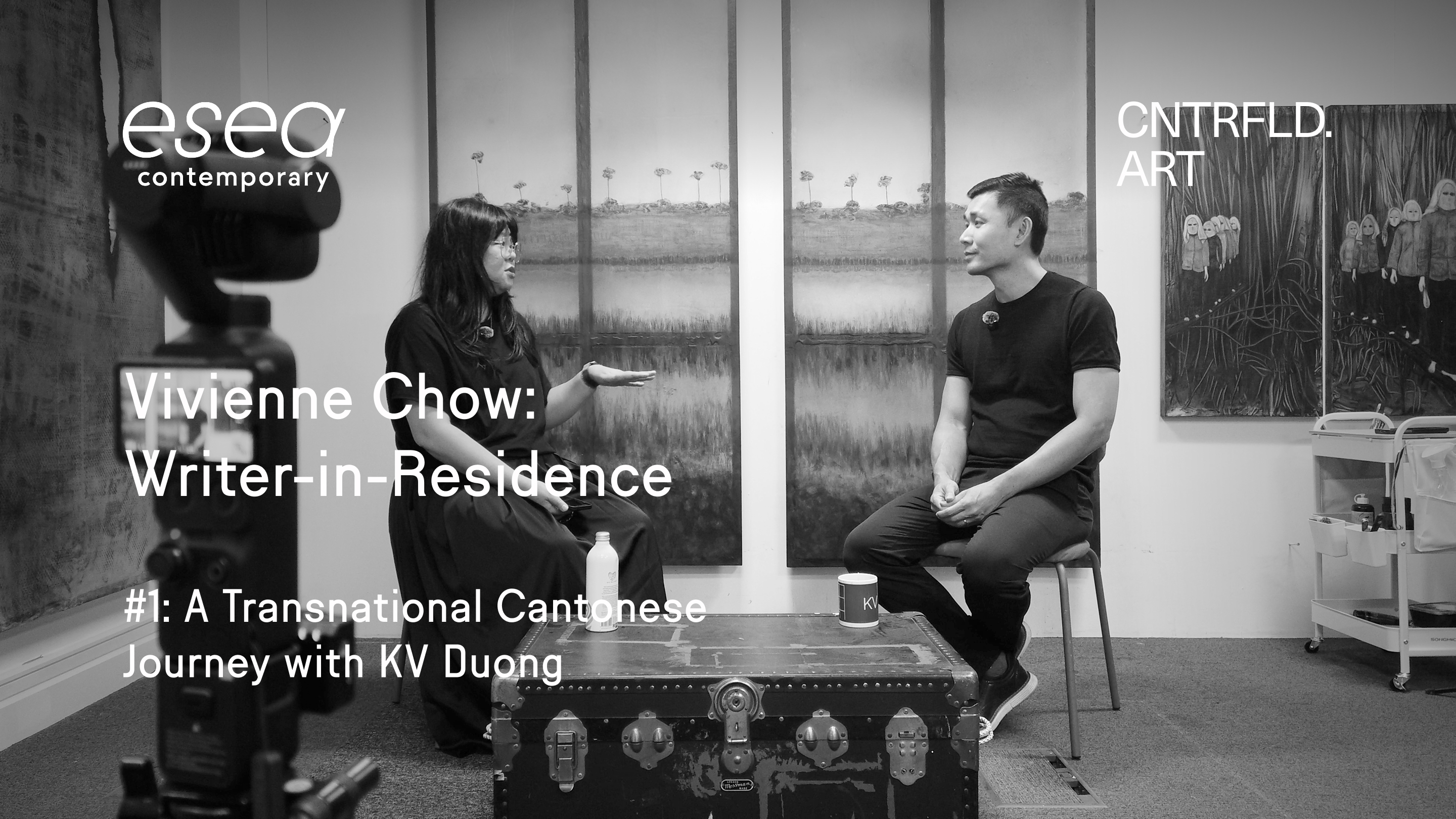
A Transnational Cantonese Journey with KV Duong
What does it mean to inherit a language, and how does it travel across generations, borders and histories? An encounter with Vietnamese-born artist KV Duong prompts writer Vivienne Chow to reconsider her own roots, uncovering unexpected connections between Cantonese diaspora communities, the Vietnamese refugee crisis and her family’s experience of displacement in colonial Hong Kong.
Through Duong’s artistic practice and personal history, this essay explores the cultural identities shaped by migration, the traces of colonial histories, and the ways in which art can reveal connections between seemingly distant communities.
Reflecting on the relationship between language, memory and belonging, Chow moves between artistic encounters, family histories and overlooked episodes of the past to consider how histories of displacement continue to shape diasporic identities across generations. As personal and collective memories intersect, she explores how the legacies of migration might offer new ways of understanding our shared histories.
by Vivienne Chow
Displaced by the Displaced: Cantonese Heritage, Migration and Hong Kong Untold Stories
by Vivienne Chow
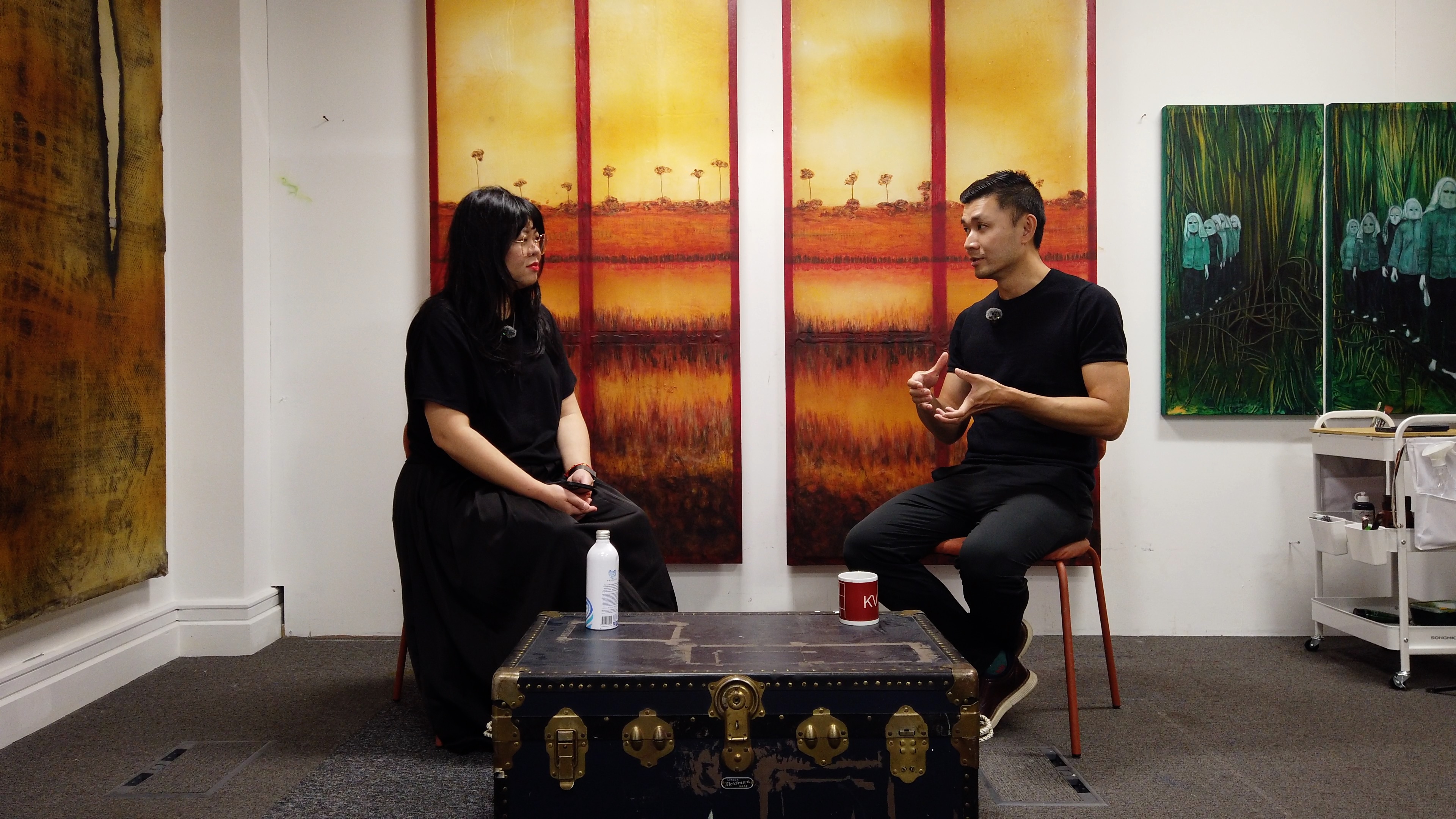
The first time I met the artist KV Duong was at the opening of Where Wound Becomes Water, his first solo exhibition at Pippy Houldsworth Gallery in January 2026. I went there mostly out of curiosity—an emerging London-based Vietnamese artist getting to show with a reputable London gallery is a major event in the ESEA art community.
My hunch was right. The gallery was crowded with friendly faces who looked like me, mingling with those from diverse backgrounds—my sensitivity towards people’s ethnicities has sharpened after I relocated to London from Hong Kong, where nearly 92 percent of the population is Han Chinese. If I had to pinpoint a moment when I realised how much I had come to appreciate London, this was it: a culturally diverse crowd coming together to celebrate an artist's work.
My little moment of indulgence was briefly interrupted when I was introduced to the star of the show. I had my art opening icebreakers prepared, but rather than asking a question—my standard approach as an art journalist and writer—I was caught off guard by one.
‘Do you speak Cantonese?’ KV asked.
Instinctively, I answered yes, despite my confusion. Why would he ask me that? Wasn’t the artist Vietnamese?
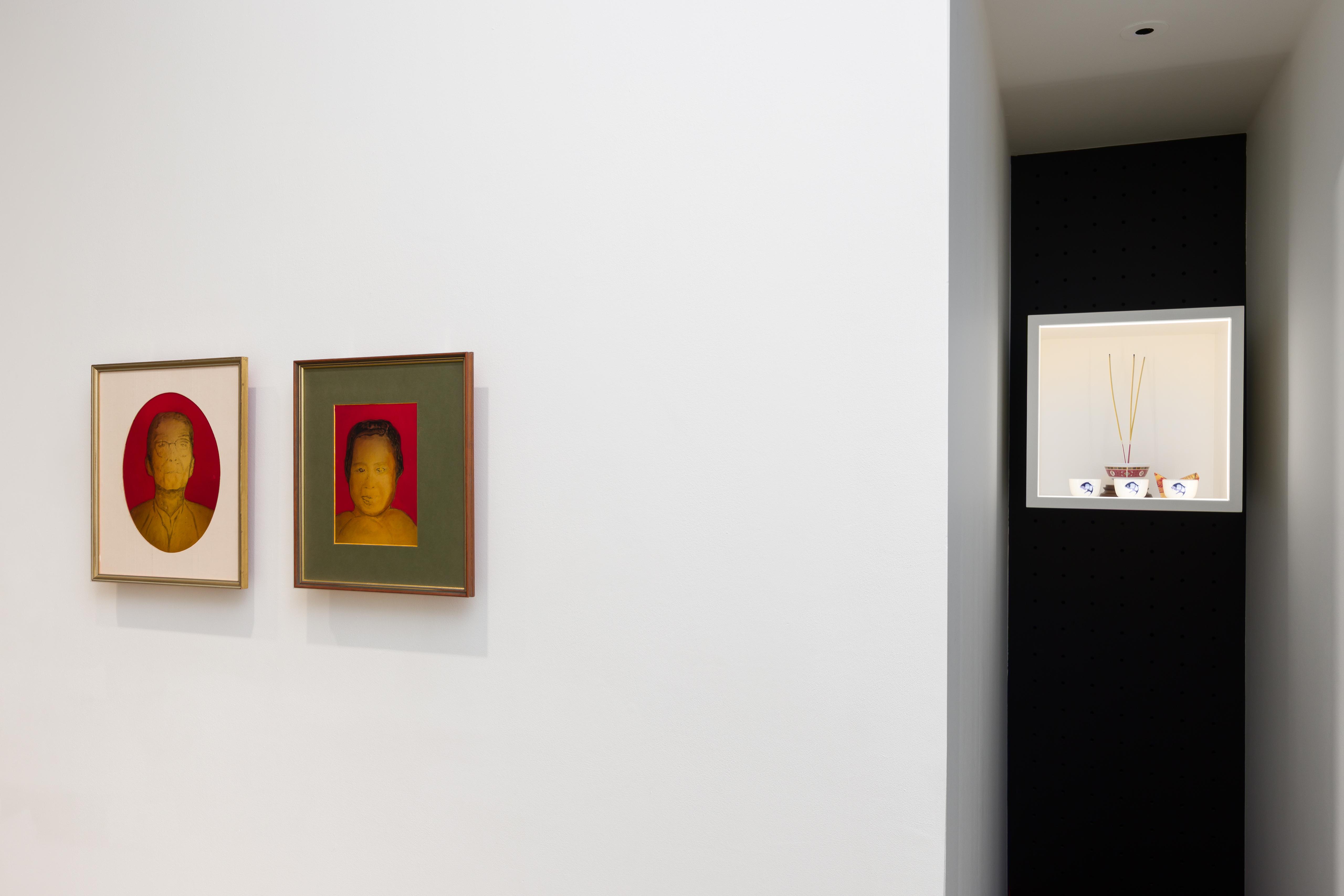
I scanned the gallery space and noticed something strangely familiar. Located near the entrance was a small installation resembling an altar commonly found in our homes where we pay respect to our ancestors. There was no ancestral tablet, but there were three sticks of incense planted in a bowl with Chinese patterns similar to the one I grew up with. Further down the corridor, pictures of elders were hung in a fashion reminiscent of those of my ancestors in my family’s home in Hong Kong. Had I come to the right place? Was this an exhibition by a Vietnamese artist or someone else?
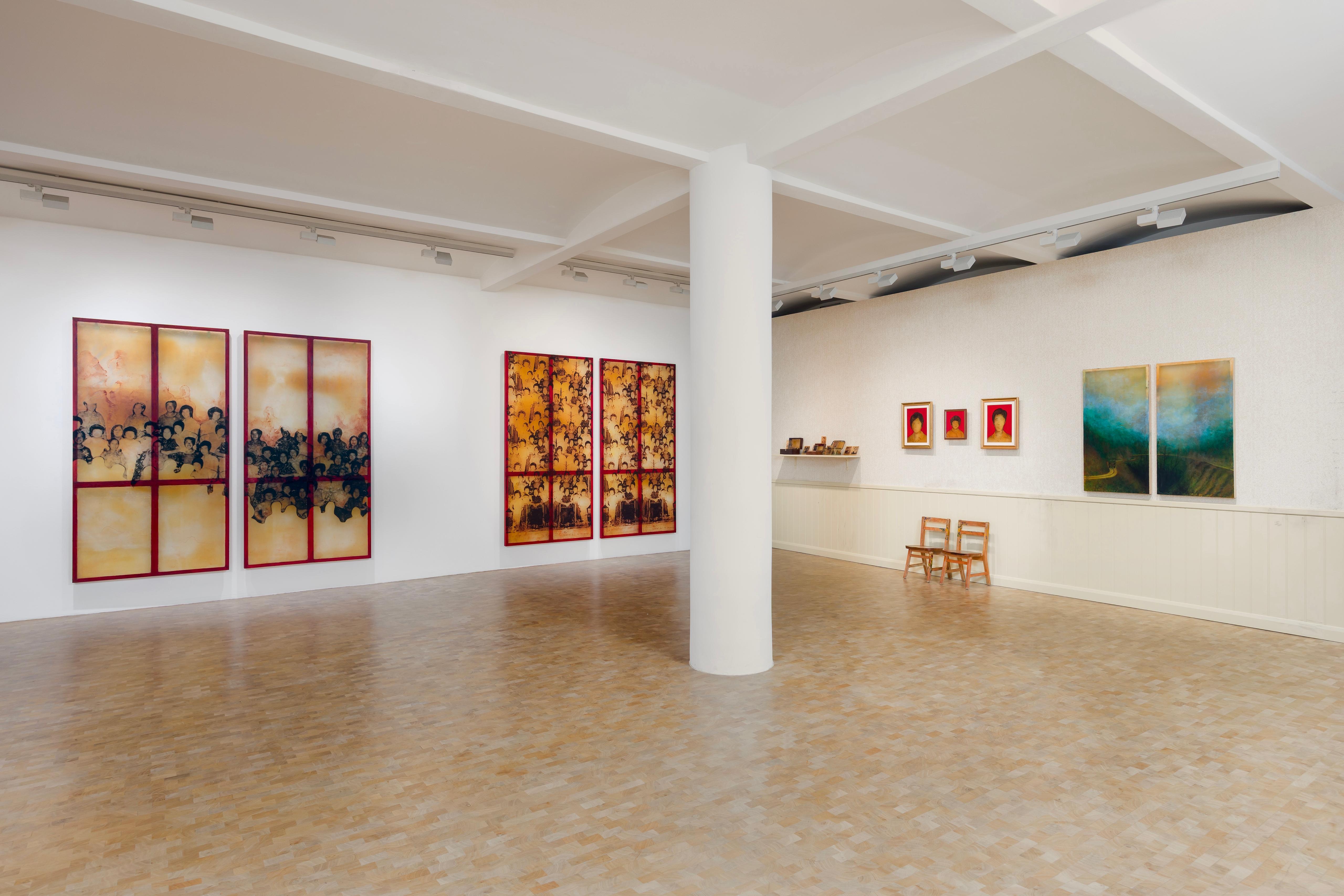
I later learnt that the London-based artist was born in Ho Chi Minh City into a family with a long Cantonese heritage. He emigrated to Canada with his family at the age of seven. He went on to become a structural engineer, working in the corporate world for nearly two decades before pursuing an artistic career full-time. His paintings of his home country's landscape, scarred by the Vietnam War, and his depictions of family members are emotionally powerful and relatable. His use of latex rather than canvas speaks to the complexities of Vietnam's colonial history and LGBTQ+ identity, offering layered perspectives on the past, present and future. His art is not made for a small circle of elites, but speaks to a wider audience who can relate to and empathise with these stories.
But it was KV’s question about my Cantonese that sent me into deep reflection.
Cantonese Beyond Hong Kong
Am I just a Cantonese speaker or more?
I was seldom asked which languages I spoke; I had always taken them for granted. No one would normally ask me that in Hong Kong or London. Occasionally, I might be asked by people from Hong Kong who had recently relocated to the UK. Some 170,000 Hong Kongers have moved to the UK since the launch of the BN(O) visa scheme in 2021, and they might prefer to converse in their mother tongue as a way of holding on to their identity while building a new life away from home.
For as long as I can remember, Hong Kongers have embraced Cantonese as the de facto official language, following successive waves of migration over the past century. Cantonese became increasingly prominent, while other indigenous dialects spoken prior to the mid-19th century, such as Weitou (圍頭話), Hakka (客家話) and Tanka (蜑家話) gradually phased out. We take pride in our language and the culture associated with it, from Canto-pop to Hong Kong cinema and television, which were exported across and dominated East and Southeast Asia once upon a time. Over the past decade and a half, however, Hong Kong has become increasingly inward-looking. The city has been so consumed and overwhelmed by its own struggles that it seems to have forgotten how outward-looking and open to other cultures it once was.
KV’s question pulled me out of this way of thinking. Cantonese is widely used not just in Hong Kong, but also in Guangdong in southern China, Macau, parts of Southeast Asia and many Chinatowns across the world. His trajectory reminded me of the long history of Cantonese migration: his ancestors were born in Vietnam over a century ago, and to this day, KV still manages to speak basic Cantonese with his family today. As a language, Cantonese is more resilient than I had imagined. Generations of migration and dispersal have yet to kill it. Rather than belonging neatly within certain geographical boundaries, it transcends time and space, acting as a thread connecting communities across the world as well as our elders and ancestors. Cantonese is more than a language. It is the emblem of resilience, a cultural DNA embodied in our upbringing that continues to shape who we are today.
The British Role
KV told me that he left Vietnam in 1987, amid a humanitarian crisis shaped by decades of conflict, from the Vietnam War (1954–1975) to the Cambodian–Vietnamese War (1978–1989). According to a 2016 report by Alexander Casella, who served as director of the East Asia Bureau of the United Nations High Commissioner for Refugees (UNHCR), the Vietnamese ‘boat people’ refugee crisis lasted 21 years. People such as KV and Oscar-winning actor Ke Huy Quan were among those who left Vietnam as children.
Although KV did not set foot in Hong Kong during his journey, his story brought back many of my childhood memories.
Growing up, I constantly heard about the Vietnamese boat people crisis in the news. In 1979, Hong Kong was designated a port of first asylum by the British colonial government. Quan was among those who arrived in Hong Kong before eventually resettling elsewhere. Many refugees were housed in camps, some of which were closed, meaning residents were not allowed to leave the site. These devastating stories were also brought to the screen in films such as New Wave director Ann Hui’s Vietnam Trilogy: Below the Lion Rock: The Boy from Vietnam (1978), The Story of Woo Viet (1981) and Boat People (1982). Hong Kong cinema at the time was about more than kung fu and action-packed crime thrillers. It also addressed major socio-political issues affecting everyday life, as well as those of our neighbours.

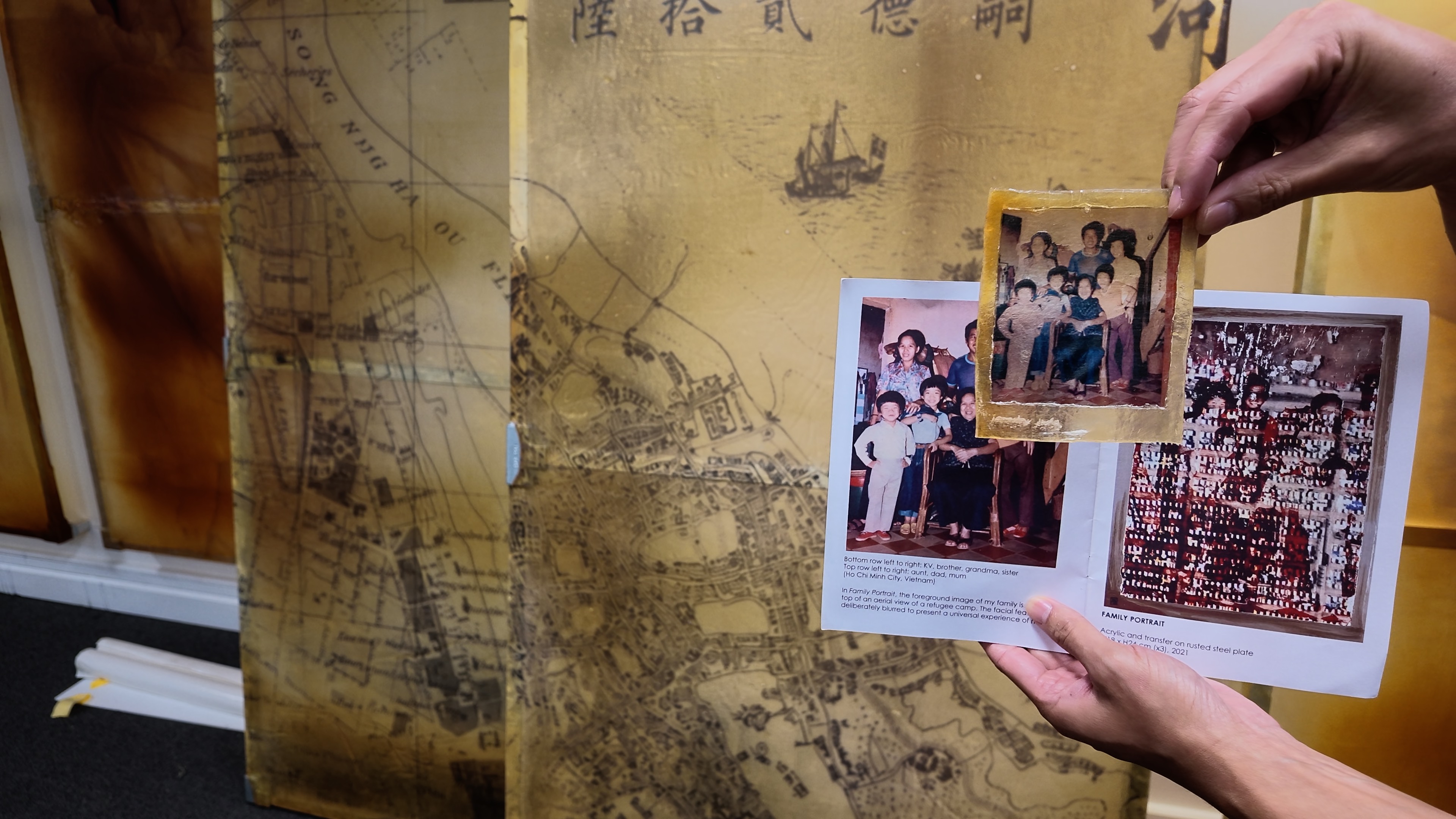

Displaced by the Displaced
Hong Kong continued to operate these detention centres for Vietnamese boat people until May 1998, after the city’s status as a port of first asylum was revoked in the same year. The crisis gradually faded from collective memory, but one episode will always stay with me.
My Cantonese heritage comes from my mother’s side of the family. My father’s side has a less straight-forward story. My late paternal grandparents and my granduncle were the last people living on Tai A Chau, a far-flung island in the Sokos Islands group that lies near the southwestern edge of Hong Kong’s territorial waters. There was no fresh water supply or electricity, nor were there any other facilities. They were indigenous inhabitants of neighbouring Siu A Chau, our smaller ancestral island, and had at some point moved to the larger island. They spoke a dialect I could not understand. My family said it was a variation of Hakka that was no longer spoken after they moved to town in the 1970s and adapted to speaking Cantonese—my mother tongue.
My father and his siblings were born on Siu A Chau. Growing up, I was told that their life was tough, trying to make ends meet by fishing and farming—quite a contrast to the cosmopolitan image of Hong Kong. The lack of proper public transport was also a pain. As they grew older in the 1970s, they began to move to Cheung Chau, an outlying island that was comparatively more urban. Other villagers also left one by one. Some moved to Lantau, the biggest outlying island in Hong Kong. Eventually everyone left, except my grandparents and my granduncle, who later also moved to our island.
Cheung Chau was where I grew up. From what I learnt from my primary school mates and observing my family’s interaction with neighbours, I already understood that we were no ordinary islanders.
Every time my grandparents came to see us, they had to journey through rough seas on a small boat for well over an hour to bring us fresh seafood—despite the fact that they could not swim and there was no such thing as life jackets. On their island, they lived in an old house by the sea, sustaining themselves by gathering shellfish from rocky crevices, catching fish, farming pigs and growing their own vegetables. Their lifestyle might be rather primitive in the eyes of city dwellers, but they seemed to be satisfied with it. They were even featured on TV news and in a Japanese newspaper. I recall asking my grandmother why they did not move to the island to live with us, but she only responded that they would never get used to an urban life.
Then one day, they had no choice but to flee.
My grandparents, who were the last two residents on the island, were forced to leave the island when it was requisitioned by the British colonial government “decided in a panic” to make it a base for Vietnamese refugees and boat people in 1989, the South China Morning Post wrote.
As the first port of asylum, Hong Kong faced the crisis of an influx of Vietnamese refugees at the time. In June 1988, a policy was introduced to classify “boat people” as non-refugees and they would be repatriated to Vietnam, as the then British colony exceeded its capacity. By May 1989, among the 38,000 who had arrived in Hong Kong, 24,000 were considered illegal immigrants. ‘We simply have no accommodations left for boat people… We have no more rooms,’ Michael Hanson, the refugee coordinator at the time, told the Los Angeles Times in that year.
In May 1989, 109 Vietnamese boat people were ‘towed out’ to Tai A Chau, according to the SCMP. My grandparents were still living there at the time. By the end of the month, the number went up to 350, including men, women and children, according to a Reuters report published in the LA Times on 31 May1989. They were among the 2,300 boat people arriving on the last three days in May. They were given water and food, but no shelter. The island simply had no facilities.
‘Vietnamese boat people are held on Tai A Chau solely because of the serious accommodation crisis caused by the massive influx of boat people into Hong Kong this summer,’ Geoffrey Thomas Barnes, Hong Kong’s Secretary for Security at the time, told the Legislative Council, according to a Legco paper dated 5 July, 1989. ‘[T]he continuing influx from Vietnam unfortunately makes it likely that the island will have to continue to be used in the foreseeable future.’
Soon a ‘tent city’ was set up in July, but the dire conditions and public hygiene there simply asked for trouble. The LA Times reported at the time that there was ‘no water, no food and no toilet facilities’. Without a single hot meal but surviving on biscuits and canned food, the Vietnamese at the time were suffering from malnutrition and the risk of epidemics was rated high, according to a UN report.
On 27 August 1989, a major protest broke out over poor conditions of the site, which housed more than 5,000. Soon it escalated into a violent riot, leading to a large number of injuries of both the boat people and police officers. The event was dubbed ‘24 Hours of Terror’.
My eldest uncle told me that he accompanied my grandparents to flee abruptly on the day when the riot broke out, leaving their houses and belongings behind to get on a police boat. It was chaotic, he recalled. One of my other uncles told the SCMP in 1996 that my grandparents ‘were asked by the Government to leave the island after the turmoil broke out,’ he said. ‘They did not want to leave at first.’ My grandparents, who were 75 and 69 at the time, declined to be interviewed.
I was too young to make sense of what was going on. I just knew that one day, my grandparents and granduncle turned up in the family home on Cheung Chau and they had no plans to leave anymore. An all-purpose detention centre was built in 1991 and remained operational until 1996.
While they arrived safe and sound and found shelter in our family home, looking back, they were displaced by displaced Vietnamese refugees because of events that were out of our control. Had Britain not ruled Hong Kong at the time, would the city still have become the first port of asylum and take in so many Vietnamese refugees? But as a child, I was just happy that I could see them more often.
UK: Where Our Distant Heritage Converges
Following my conversation with KV, I searched the National Archives out of curiosity and discovered more about the scale of the humanitarian crisis. A declassified document dated 14 June 1979, written by Thailand's Prime Minister Kriangsak Chomanan to British Prime Minister Margaret Thatcher, described how people of Chinese descent were being specifically targeted.
‘What is especially disturbing is that we have reason to believe that the Vietnamese Government is organizing this “human export,” who are mostly of Chinese origin, from both former South Vietnam and Kampuchea to serve a two-fold purpose, namely getting rid of undesirables of Chinese origin and at the same time inflicting on Thailand onerous economic, social and security burdens,’ Chomanan wrote in a letter appealing for support from the British government. This echoes what KV told me about ethnic Chinese people, many of Cantonese heritage, being targeted during the crisis.
Eventually, about 24,500 Vietnamese refugees resettled in the UK via the Hong Kong refugee camps between 1979 and 1992, out of an estimated 800,000 people who fled the country.
Decades later, successive generations of migrants, alongside an exodus of Hong Kongers of Cantonese heritage, have found themselves in the UK. We are living reminders of historical upheavals. Our distant lineages have somehow converged on an island far from where we came from, as we seek to rebuild our identities and reconnect with our cultural roots.
What does this mean for our shared heritage on British soil today? As Cantonese heritage takes root on this island, it will continue to evolve, shaped by our lived experiences. It is more than just a language. Inevitably, it will become part of a British story.
This essay has been commissioned by esea contemporary and CNTRFLD.ART.
Vivienne Chow is an award-winning journalist, writer and content strategist whose work explores art, cultural ecosystems and identity at the intersection of East and West. A Salzburg Global Fellow and IJP Premium Fellow, she is Writer-in-Residence at esea contemporary from August to November 2026. With over two decades of experience across Asia and Europe, she has held senior editorial roles at the South China Morning Post and Artnet News, where she co-founded The Asia Pivot. Her writing has appeared in BBC Culture, Variety, The Art Newspaper, the Financial Times and the New York Times, among others. She also founded the non-profit Cultural Journalism Campus and advises cultural organisations on strategy and research.
KV Duong (b. 1980, Ho Chi Minh City, Vietnam) is a Vietnamese-born, London-based artist whose practice explores the Vietnamese diasporic queer experience through personal and ancestral histories. Working primarily with latex, he creates paintings that investigate the intersections of memory, identity, colonial history and the body. Drawing on his background in structural engineering, Duong employs a distinctive process involving liquid latex, acrylic paint and physical mark-making. Recurring motifs of doors, portals and, more recently, metal bed frames examine ideas of access, exclusion, intimacy and belonging. His multidisciplinary practice spans painting, photography and performance.